Hydrogen Peroxide for Fungus Gnats: Does It Work?
Written by Mustafa Ayan Fact-checked against university extension/IPM sources Last reviewed: October 14, 2026
Direct answer
A diluted hydrogen peroxide drench can kill fungus gnat larvae it directly contacts, but it's short-acting, doesn't prevent new eggs, and extension guidance on it is mixed. It's an optional add-on, not part of the default plan. Use moisture control, sticky traps, and Bti first, and read the cautions before using it.
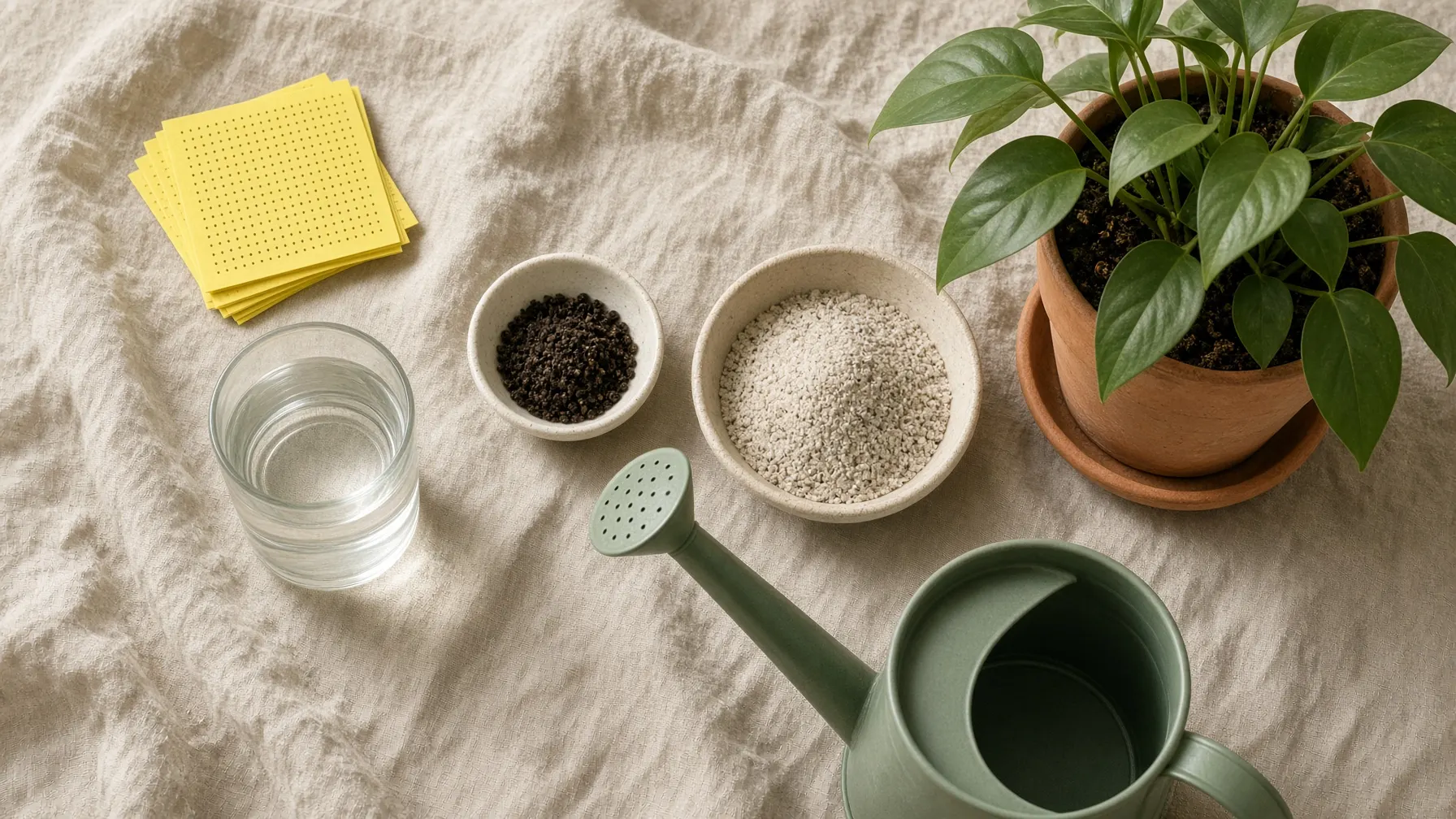
Does hydrogen peroxide kill fungus gnats?
It can kill larvae it directly contacts, which is why it's a popular home suggestion. But it's short-acting, it doesn't prevent new eggs, and it is not recommended as consistently as Bti or dry soil. If you want a dependable larvicide, use Bti first.
Why this is optional, not a default step
A diluted hydrogen peroxide drench is a widely repeated home suggestion, and the basic mechanism — oxygen release disrupting soft-bodied larvae on contact — is plausible. But it isn't uniformly recommended across university extension sources the way Bti is: some describe it as a reasonable short-term option, others don't mention it as a first-line treatment at all, and none of it is a substitute for fixing the underlying moisture problem. Treat it as an optional add-on you choose deliberately, not a required step.
If you decide to use it
The dilution commonly described is 1 part regular 3% pharmacy hydrogen peroxide to 4 parts water (roughly 1 cup peroxide to 4 cups water). Higher-strength salon or food-grade peroxide is not the same product and is not a simple ratio conversion — don't substitute it.
Water the pot with the mix until the soil is evenly moist and a little drains, then let it drain fully and empty the saucer. This drench is a full watering, not an extra one — time it for whenever that pot was due for water anyway, and let the top of the mix dry out again before the next round, however long that takes for that specific plant.
Cautions
Spot-test on one plant first, especially delicate ferns and seedlings. Peroxide is a short-term contact treatment — it doesn't stay active in the mix the way Bti does, and repeated use may also affect beneficial soil microbes, which is part of why it isn't the default recommendation here.
Succulents, cacti, and other drought-adapted plants are already vulnerable to rot from excess moisture — a repeated liquid drench schedule is a poor fit for them regardless of what's in the water. If gnats are breeding in a succulent's mix, fixing drainage and watering frequency matters more than any drench.